…in Vietnam in 1972, a child born of a Vietnamese woman, Huong, and an American soldier, Rich. Lena’s father, unaware of Houng’s pregnancy, had left Vietnam eight months prior to her birth in Da Nang. All of the paperwork necessary for Huong to join Rich in the United States had been completed. They were both excited for the next phase of their journey in the US. Rich left Vietnam on April 18, 1972.

During that week, the North Vietnamese communists swept into South Vietnam across the Demilitarized Zone with Soviet tanks in an offensive that would come to be known as the “Easter Offensive”. These motivated, professional armies captured a number of the northern provinces in South Vietnam. The American military was all but gone from Vietnam by this time, the South Vietnamese were on their own.
The war would go on for another two long years, as the parallel Viet Cong governments began to assert themselves in villages throughout South Vietnam. It was only a matter of time, and villagers who had a past connection to the United States military became increasingly uncertain about their future. And soon, the finger-pointing in villages began, many of those fingers pointed directly at light-skinned, obviously Amerasian Children.
Lena was born into this cauldron of suspicion and hate. Her mother burned all of her legal transit paperwork one afternoon in a small bowl in her room. Huong feared being caught with documents that would seal her fate were she to be captured with them. Leaving Lena with her mother Phai, Huong fled for the mountains above Quang Ngai, a remote place of family and safety. Lena and Huong would be reunited some months later, but Lena’s life was by that time the dark existence of a recluse. She was not allowed to go outside to play with other children, although at times her grandmother relented and rubbed black soot from the cooking fire on her face and arms to make her appear darker.
Often referred to as Bui Doi (dust of life), young Amerasians faced an unpleasant and often cruel existence in the villages and cities of Vietnam. Protected by her Grandfather, Dat, and Grandmother, Phai, Lena survived her early years, trying desperately to get out of Vietnam, first through the Orderly Departure Program, then (successfully) through the Amerasian (American) Recovery Act. Lena’s mother was sent to a reeducation camp for 4 years from 1976-80 and was in and out of her life during this time.
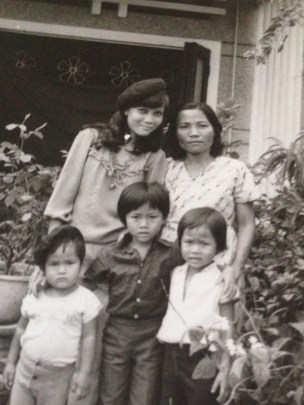
Lena left Vietnam in 1988 at age 16 with her grandmother, Phai. Her mother Huong would never see the United States.

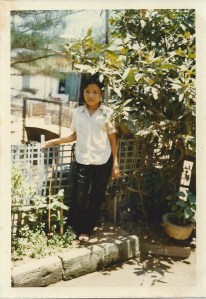
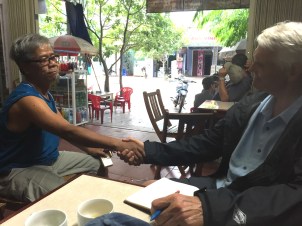
 Chickens, dogs, and cattle milled about the newly planted rice paddies, her back yard, and occasionally the kitchen. Although she has been forced to move many times, Loc has lived in this area with her husband and 9 children since the end of the Vietnam War in 1975.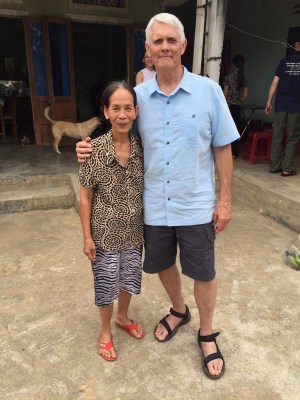

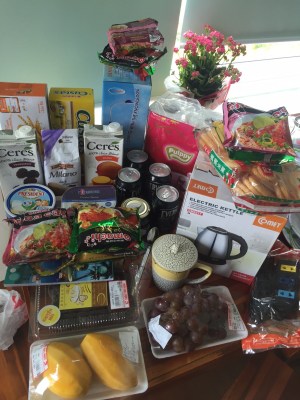
 I tell Tam so and the haggling in Vietnamese begins. I can only follow through reading facial expressions, and that reading tells me it’s not going our way. Suddenly, Tam wheels and starts off to the street. I follow. A shout in Vietnamese from the shopkeeper, a middle-aged, weary looking woman, stops Tam in her tracks, me putting on the brakes to avoid a collision. Tam smiles at me sweetly and says simply, “200,000”. That works out to $8.92 US. I peel off the 200,000 Dong, hand it to the woman with thanks, grab the table and we’re loading back up on the motorbikes when another shouted phrase erupts from the shop. Lynda translates, “You bring an American to shop and the least you can do is let me make a dollar!” I love the table. Thanks Tam.
 I was in basic training in the United States Army, mom visited me when she could. When I was stationed in the Republic of South Vietnam, mom would send packages of chocolate chip cookies, my favorite (and as it turned out the favorite of the troopers I served with).
 I sit waiting patiently for my plane that promises to take me from San Francisco, USA to Da Nang, Vietnam. As I mentally prepare for what lies ahead, I feel deeply grateful that I have the time, resources and family support that make the telling of this tale possible.
 There are many moving and often unpredictable parts to an operation of this size. I’ve spent the last couple of weeks working to insure that the ranch will run smoothly in my absence. The hay barn is full, both tractors are serviced and running properly (amazing!), all of the supplies for Summer Horse Camp are delivered and packed away. I can go.

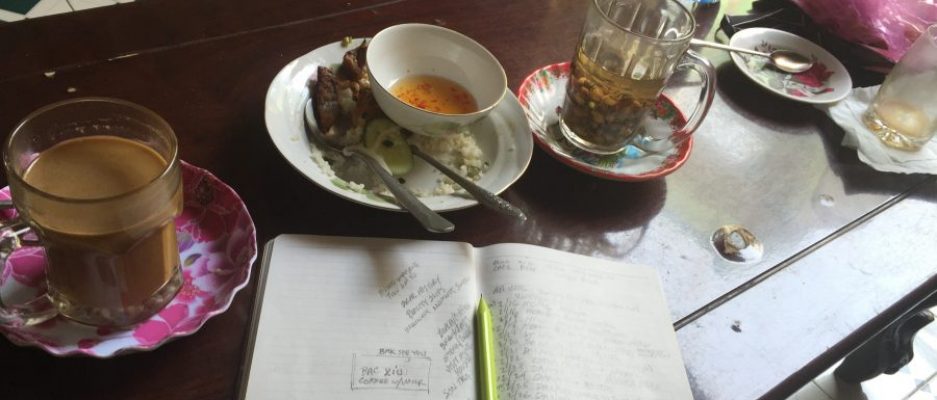
 letterfromlena