One Year Ago Today.

My dad, Dick Allen passed suddenly one year ago today near his home at Paradise Valley Estates in Fairfield, CA.

IMG_1959
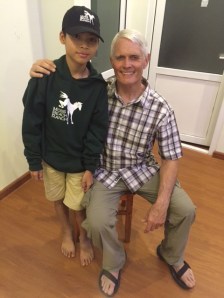
Dick and Son

During the months following the death of my mother Joyce in January 2015, dad’s health improved slowly (he caught pneumonia when mom entered the hospital for the last time), but his depression would not lift.  He had lost his partner and companion of 65 years and seemed lost, incomplete.  I stayed with him off and on during this time, encouraging him to eat, taking him shopping and out to the occasional movie. We talked about many things, subjects neither one of us had time or the inclination to discuss before.  We talked about death, his only concern that he would go quickly, no lingering hospital stay for him.  He told me, for the first time, about his experience in Vietnam.  I told him, for the first time, about my time in Vietnam.  Strangely, even though this was a shared experience separated by only 7 years, we had never told each other the stories, the kind of war hyperbole only buddies share.

Over the course of a few months, dad got to know what it was to be alone, save for his devoted dog Kami.  And while we never had even one conversation about what would happen to Kami if he were to pass on, he told me repeatedly that he didn’t know what he would do if she were to leave him.  He loved that dog dearly and fed her from his plate at the table to prove it.  He never imagined she would be the one left behind.

I was constantly after my father in the spring of 2015 to get some more exercise.  I told him about the pool in his community that had a daily exercise class for men.  More of a stretching class than anything else, only a block and a half from his house.  He of course didn’t walk to the community center, he took the Lincoln.

But not to the pool class.  Turns out my hero, fighter pilot dad doesn’t like the pool.  Didn’t say he was afraid, just didn’t like it.  Then he told me the story of the Delbert Dunker.  When he was in flight training in Pensacola, Florida, one of the training exercises included a ride on the Delbert Dunker into the pool.  This device simulated a fighter aircraft cockpit and with the student pilot strapped in would hurtle down a set of rails upside down into the pool.  The student pilot was left on his own to unstrap and make his way to the surface.  While my father became a Naval Aviator and flew a number of fighters on and off aircraft carriers, he never got over his distaste for the Delbert Dunker and of course, the pool.

One day in June as I got into his Lincoln for a weekly grocery trip, I noted a pair of swim trunks on the seat between us.  “Going for a swim?”, I wisecracked.  He sheepishly mumbled that he was thinking about it, but don’t rush me.

On June 23rd, I got a call from the facility manager at Paradise Valley Estates.  Dad was attending his first pool exercise class that day.  On entering the pool, before even one tentative stretch, he walked immediately to the side and sat on a bench and died instantly from a massive coronary.  He was gone before they got to him. Dad got his wish as he had described it,  a lightning quick end to a beautiful life.

But dad is still here with me, right over there, big grin on his face as he patiently explains, “I told you I don’t like the pool.”  He outlived his wife Joyce by less than five months.
Saying Goodbye to Vietnam For Now

IMG_0018
Moss Beach Ranch Outpost in Danang, Vietnam

Saying Goodbye to Vietnam on Memorial Day brings a torrent of thoughts and feelings, some old, some new.  I didn’t consider the seeming contradiction when I booked my return flight home, but now as I prepare to head out to Da Nang for the flight to Seoul and then home to San Francisco, I can’t help but consider the wild card that was thrown my way.

Like most Vietnam Veterans, I don’t “celebrate” Memorial Day.  I pause on this day of remembrance and honor those who were called to make the ultimate and final sacrifice.  Not one of those men or women chose the path fate carved out for them. Each and every one of them is an American hero.  I thank God that I am not among them.

It is impossible to be here in Da Nang on this day not to think back to when I was here 45 years ago.  We lost many Americans during our time here fighting a war that will always draw a debate.  The Vietnamese on both sides lost millions of soldiers and civilians fighting the Chinese, the Japanese, the French, the Americans, and themselves over the course of more than a century.  Yet, two-thirds of Vietnam’s population are too young to remember the war years.  They are the future of a growing, vital Vietnam. Change is in the air everywhere you turn in this beautiful country.  I am so thankful for my return to Vietnam this year to witness a young, energetic nation of hard-working people building toward a brighter future.  Paradoxically, my original experience in Vietnam was one of war — this experience, years later, has brought me peace.  Goodbye for now Vietnam.

Lena’s Morning

IMG_3316

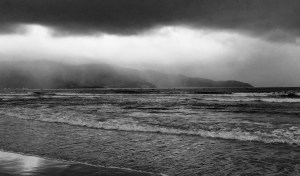
Huynh Khanh Trang squats in the dust at dawn.  She has stopped to inspect a peculiar shell lying in the road that glints in the slowly intensifying brightness of the new day.  Trang, or Lena as her mother calls her, is in no hurry.  It is early yet.  She has just now come from the beach with her grandfather, Dat.  The early ride to the beach on her grandfather’s bicycle is the morning ritual she looks forward to eagerly each day. This is her quiet time with Grandfather that they share together alone as the quiet South China Sea comes slowly to life.

Lena’s grandfather has been her almost constant companion since her mother fled to the country.  After the Communist Easter Offensive in 1972, the year of Lena’s birth, her village on the outskirts of Da Nang has become an uncertain place.  Anyone who has an “American connection” lives in fear now that the Communists have taken control of her village.  Anyone who worked for the Americans, sold to the Americans, loved an American, is in danger.

Lena, an Amerasian girl, born to her Vietnamese mother and American soldier father, knows this.  It is why her mother had to go away to hide in Quang Ngai.  It is why she is rarely allowed outside during the day. When she does go out, her grandmother generously applies a layer of fireplace soot to her face and arms to make her skin appear darker.  Lena has fine, high cheekbones like most of her Kinh race, but her skin color is obvious evidence of mixed blood.

Often Dat will bring a book with him on their trip to the beach, a children’s book in English that he will read to her slowly, carefully, yet loudly.  Dat believes that the louder one speaks English, the better it will stick in the memory.  Four year old Lena believes this, and when it is her turn to read a sentence or two from the book she will read as loudly as she can.  There are few people on the beach at this hour, but those passersby don’t seem to mind.  An old man and his granddaughter should be free to have their moments as they choose, even to speak a language that is of no use anymore.  The Americans have gone and taken their confusing language with them.

The year is 1975 and the Communists are still celebrating their great victory in Vietnam.  Soviet tanks crewed by hardened veteran North Vietnamese soldiers crashed through the gates of Independence Palace in Saigon on March 30 and the seemingly endless war was over.

That same day, Dat carried young Lena on his shoulders to the side of the wide Duong Duy Tan in Da Nang to watch as 100,000 North Vietnam Army soldiers marched past.  There was little cheering.  For the most part the civilians in the crowd lining the boulevard were silent, many with bowed heads, eyes downcast, as the troops filed by. If this was a liberation, it was a solemn one indeed.

Later that night, there would be much shooting as the Communists celebrated their victory. The victorious soldiers looted liquor and food stores, firing wildly into the night with AK-47 automatic rifles.  Many of those bullets fired in jubilation would find their mark, killing and wounding a number of unsuspecting civilians. This was not a safe night to be on the streets of Da Nang.

Dat had pulled the heavy steel doors closed across the front of his shop.  The stainless steel chain and padlock were of course no deterrent to the marauding troops, one burst from an AK-47 would have taken care of that.

Dat’s shop was a novelty and souvenir shop left over from the not too distant days when American troops would spend Military Payment Certificates (MPC), or sometimes even US dollars for trinkets to remember their time in Vietnam. The glass display case featured Zippo lighters with engraved military insignia, photo albums emblazoned withVietnam map covers, posters that read “When I Die I’ll Go To Heaven, Because I’ve Spent My Time In Hell”, marijuana rolling papers and intricately carved ivory pipes.  This collection of American has-been debris was of little interest to the victorious Communist soldiers.  Tonight they were after alcohol, food, and tobacco, none of which lined the nearly bare shelves of Dat’s small shop. The kerosene lamps inside remained unlit.

Peering out through the louvered window slats, Dat and Lena stayed quiet and still, she on his lap, his arms wrapped tightly around her.  Often a question would come to Lena’s mind, but as she turned to whisper it to her grandfather, he would quiet her with a faint “im lang” as the boisterous revelry swirled down the dusty, littered village street.

This was Lena’s first look at the men who had been her father’s enemies.  Not that she had known her father, he had left Vietnam three years ago well before she was born. But her mother and grandfather had kept him alive in her mind and told her daily that he would soon be coming back to Vietnam to take them away to the United States.  This new development, this communist victory, seemed a complication to that plan in Lena’s inquisitive young mind.  These men having their way with her village seemed so confident, so sure of themselves, how was Lena’s father to return to fight them all and rescue her and her family?

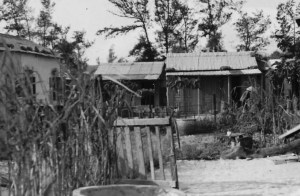
NeighborhoodB111 (1)That terrifying night now a fading but persistent memory, Lena straightens to peer down the  main street of her small world.  Her interest still fixed on the shell in her small hand, she is distracted; not by a noise, but by the silence.  Looking about she sees her village as it is, wood structures lining the road, tin roofs, the street unkempt, trash blown to the side up and down the street, a tree or two here and there, the smoke of freshly lit cook fires, people beginning another day in Khu Dinh.  What has distracted her are the birds.  Lena has always loved to watch and listen to the birds in the early morning light. But this morning, they don’t sing, there is only an eerie quiet.  She remembers the sweet songs of the birds in the early morning, yet now there is no song to blend with the other familiar sounds.  The birds just don’t sing anymore.

1971 Flashback – Rich Arrives Vietnam

1971 Flashback – Rich Arrives Vietnam

IMG_0069I had just turned 19 years old when the Pan Am 707 banked left and turned toward the runway in Cam Ranh Bay, Vietnam.  The 150 healthy, clean, and newly outfitted soldiers on board all strained to see what little they could out of the cabin windows, most looking into that fierce bright light for the first time on the fantasy-green country the lucky ones would call home for the next 365 days.
Uncertainty and expectation blended for these untested men in ways unique to each: fear, excitement, dread, crazy macho war-movie fantasy stuff that wouldn’t last.  The possibility of indifference didn’t have a seat on that Boeing flight.

My own journey would start that day far away from my ultimate destination, the war a makeshift stage, a backdrop to adventure, indulgence, joy, loss, and in the end, enough guilt and shame to last a lifetime. But for now, in that moment, my journey would take me north to Da Nang where fate would greet me with open arms.

In 1971 the United States Army was working furiously to turn the Vietnam War over to its rightful owner, the Vietnamese.  Our Commander in Chief, his advisors, and the American people thought this a good plan.

They called it “Vietnamization”.  An ill-conceived plan at best, Vietnamization was supposed to improve and modernize the South Vietnam Army (ARVN), transfer the day to day fighting from the American Grunts to the ARVN, and withdraw all American troops from Vietnam.  Sounds like a great plan — unless you were one of the soldiers there during the process.

There was a black joke that went around in various forms during that time, told and retold, about being the last guy to get killed in Vietnam.  Nobody wanted to be that guy.  The deterioration of discipline and morale for US troops during this chapter of the war was devastating to soldiers and commanders alike. Even new guys like me knew we were leaving Vietnam without finishing the job.  A spiritual malaise spread over our army like a thick fog.  Drug abuse was the fastest growing noncombat death occurrence and race problems had gotten so out of control that it sometimes resembled open racial warfare.

The unit I was assigned to was stationed on the outskirts of Da Nang where we worked with ARVN units to supply and train them well enough to somehow stave off the communist onslaught from the north.  In the end, they would not – but that outcome was still down the road apiece.  All of us would have to lose more, much more, before the final chapter was scratched out.

A thrilling ride from Cam Ranh Bay in a C-130 aircraft got me to Da Nang late afternoon.  Because I was a single replacement traveling alone, it was for me to find a ride to my unit –just the first of many times in ‘Nam that nobody really knew, or cared, what was going on.  I bummed a lift in a Jeep headed for Marble Mountain and finally reported, as ordered, to Company First Sergeant Thomas.

Top, a burly black man with bad skin, is one of those lifer soldiers who fought his way up the ranks and has seen and heard it all.  He is at the end of his career and he is short, meaning he has less than thirty days left on his tour in Vietnam.  A combination that guaranteed he doesn’t  give a shit about anything or anyone.  Predictably, he has no interest in my case and quickly passes me off to the company clerk Coleman who also doesn’t give a shit but has no one to pass me on to.

After a mostly two-fingered typing session called “processing”, Coleman took me to the supply shack to draw my gear and weapon, then told me to find an empty rack in hooch 12 or 13, he wasn’t sure which.  Pointed me down the dirt path and that was it.  I was in.IMG_4050

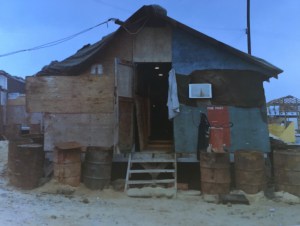
I knocked on the door of hooch number 12 (it was closer and seemed to have a cooler vibe than 13), the “12” numeral painted freehand on the unpainted plywood by the door.  The hooch was surrounded by sand-filled 55 gallon blast drums, more sandbags piled high on top of them to take the shrapnel from the intermittent mortar rounds that would fall most nights.

The door opened a crack and a black trooper with a fully picked-out afro said, “What?” I told him the obvious, “I’m a new guy and Top sent me down here.” “You cool?”, he asked.  Simple question, but in Vietnam at that time, in that moment, you better be sure.  “Yeah, I’m cool.” He opened the door wide enough for me to throw my duffle in and climb the couple of steps up and into the darkness.

1964 Flashback

IMG_04721964 Flashback – Dick leaves for Vietnam
My father and I had said our goodbyes many times in my young life, this was how it worked in military families.  Dad was a Navy fighter pilot, his job took him away from home more often than not.  There would be a lot of commotion for a couple weeks and then dad was gone.

This goodbye, this moment of going off to war, was different.  This time dad was going to a dangerous, dark sounding place — Vietnam.  There was a charge to this goodbye, an excited tension and seeming finality.  Maybe it was my age, just turning 12, able to understand what was at stake for the first time, but it was worlds apart from any previous goodbye.

I remember clearly standing, alone, just the two of us at the door, dad anxious to get on with it, me drawing it out to the best of my adolescent ability. This house, one that dad had only occupied for a brief time and would be mine for the next year seemed like the last safe place. Once out that door there were no guarantees and I was trying my best to make it last.  Crying.  Alone together, he tried to comfort me in the only way he knew.  He assured me he would be back, instructed me to take care of my mother and the kids, told me that the only reason he was going was so that I would never have to go.

Hearing those words in my mind now it sounds like the most bullshit of reasons, a worn out World War II line, but that was how we talked in those days, Communist Threat, Domino Theory, Making the World Safe for Democracy.

It’s what we believed, maybe more belligerently in military families, maybe we all thought that way.  I don’t know what dad really believed about that war,  but I know for sure that he had no idea that the little war he was headed off for in 1964 would still be raging seven years later and that I would get my own chance to walk out that door.

This is hard.

This is hard.  Harder than I ever thought it would or could be.  Not the writing, the writing is going well.  Better than I have a right to expect and I am so grateful that I have the opportunity, the time and the means to take a short break to tell my daughter Lena’s story.  IMG_4020I’ve spent just over a month in Vietnam this year meeting and growing to love my new Vietnamese family.  This is where I am supposed to be, right now, in this moment doing exactly this.
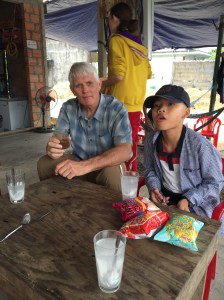
But telling the story that spans generations and brings into sharp focus events unrelated until now is a sobering responsibility.  Some details of the story can’t, and won’t ever be told.  Some of the story is so heartbreaking that it’s almost impossible to write.  Fragments of Lena’s story are so elegant and the characters so courageous that I’m humbled no matter how many times I hear them, write and re-write them.  Feeling so blessed to have the strength in sobriety to be able to carry this message.


Spent the Day Up North…

IMG_4008…in Quang Tri and the ancient imperial city of Hue today. So grateful that this story takes me to the far corners of what was once the Republic of South Vietnam.  This country is so beautiful and diverse – I asked my traveling companions from Da Nang today as we were traveling north on Highway 1 along the coast if there was any difference between people in Da Nang and people in Hue and Quang Tri and the unanimous response was, “up here their accent is funny and the people are fake”. Guess that settles that.

While we were in Hue this morning my ankle, that has been giving me trouble after abusing it in the rice paddies earlier in the week, decided to swell up and become so painful that I couldn’t walk.  We were in a small coffee shop talking about it when a woman told us of an elderly woman nearby that heals with her hands and herbal remedies.

What the hell.  We load up and follow her down a narrow lane to a beautifully kept house with flowers and herbs of all varieties growing in every corner of the yard.  We wait outside while the woman goes inside to negotiate my treatment.  My interpreter Lynda is standing next to me and can hear every word spoken inside. Apparently the healer’s son in law was killed yesterday in Saigon leaving a wife and three children, the youngest a year and a half old.  The woman with healing powers would like to help but she is unable to connect with her god-given healing powers. She is ashamed to send us away, but feels unable to perform in her grief.

We are really all OK with that after hearing the woman’s tragic story. Van takes one arm, Tam the other to support me down the front steps when we are halted by a voice from within.  The healer has relented and cannot let us go without giving her magic a try.  Van and Tam wheel around, me in the middle, and we make our way into the dimly lit house.  Hanging on a mirror on the wall is a full 18 inch swatch of silver human hair.  On the bed is an ancient woman with silver hair (matching that hanging on the wall), she can’t weigh 90 pounds. She motions for me to sit on a chair next to the bed and put my foot up where she can work on it.  She uses a spray unknown to me as she works my foot, probing, searching, massaging.  Finally she suggests that the swelling has gone on too long and is too severe for her to diagnose the problem.  She tells me that the foot must be X-rayed. I found myself wishing I had found her a week earlier.  We made an ambitious attempt to pay her for her services, but the woman declined any payment.  She explained that she only uses her skills on those she feels she has a special connection wth. That is good enough for me and we make our way to a nearby hospital for an X-ray.

At the clean and unexpectedly efficient hospital we learn that services are indeed available, but they must be paid for in cash prior to each procedure.  I immediately pay 600,000 VDN (about $27) to be treated by an orthopedist.  Next comes the series of X-rays which come to a tidy 300,000 (about $14).  IMG_4311After the X-rays the orthopedist shows me the break in my foot which he can treat in one of two ways.  The first will involve a couple of screws and my not being able to walk for six weeks, the other is to cast it up and deal wth it later on my return to the US. No mystery attached to my choice there.  The casting cost just under a million VDN (about $45), but was done right then and there on the spot.  IMG_4318
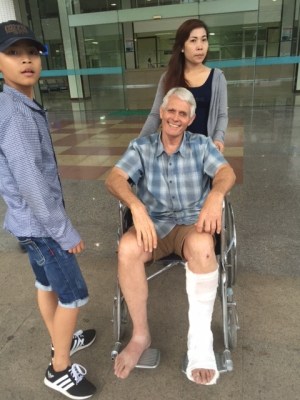
So for less than what my deductible would have been for a simple visit in the states, I was on my way.  Well, I am in a cast, but still…

Fortunately my adventuring around Vietnam was at an end anyway, On my return to the apartment in Da Nang tomorrow it’s just write, write, and write some more.  I have all the field data my body can take at this point.


They wouldn’t let me vote…

Today was Vietnam’s National Assembly election. IMG_0028.jpgThere were 870 candidates approved to run in the election, only 11 of those were not Communist Party members.  More than 100 independent candidates were blocked by the “vetting committee”, one a school teacher because his dog defecated outside his neighbor’s house.

If you live in Da Nang, you certainly couldn’t ignore the upcoming election.  All day yesterday and today trucks with blaring loudspeakers covered with red and yellow hammer and sickle signs encouraged voters to go to the polls.  If a voter failed to vote early in the day, there was a visit at home from a uniformed election official wanting to know why not.  Great political theatre here, but nothing like we have back home. Ugh.  Oh, and President Obama shows up here in Vietnam tomorrow for a 3 day visit, fortunately not here in Da Nang.  He’s busy with really important stuff in Hanoi and Saigon. Probably that little land-dispute war the Vietnamese and Chinese have going on at the moment.

IMG_0022I had two major writing breakthroughs today. One a jet-fueled energy burst where i could see the story before me in ways i hadn’t previously, my typing far behind my mind’s telling of the story.  Just a thrilling ride when that happens.  The other was a new set of facts that came to light unexpectedly, changing the story somewhat,  but on reflection bringing a freshness and richness that are a true gift.
Off to Quang Tri and Hue tomorrow with my sidekicks Lynda and Tam, and Van as I follow the story, wherever it leads.  Today one of my characters killed a 15 meter King Cobra snake with a machete.  How cool is that?

I hesitate to post this photo…

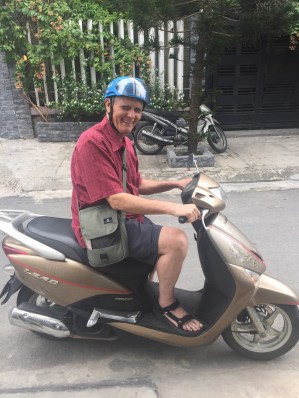
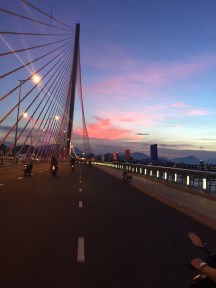
I was going for the biker look, and all I ended up with is a Vietnamese school girl on her way to class kinda look, apologies to Vietnamese schoolgirls everywhere. IMG_0024 A scooter is definitely the way to get around Da Nang, and I’m pretty sure if I keep working at it the next five years I might get it down.  Crossing any of Da Nang’s spectacular bridges at night on a scooter is thrilling, unforgettable.IMG_0021
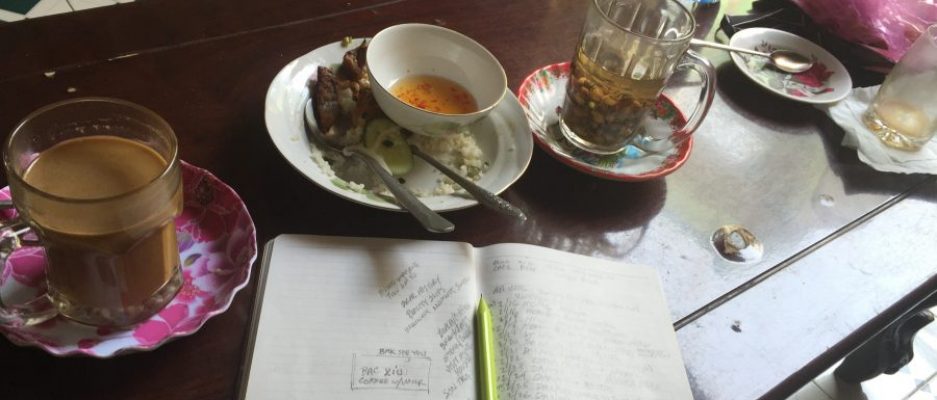
Check out the Eagle Creek, bag that I’m wearing as I get ready to head out to a cafe to do some writing.  Best piece of traveling equipment I’ve owned.  Room for my Mac Book, iPad, iPhone, journal, and backup battery charger.  IMG_0010

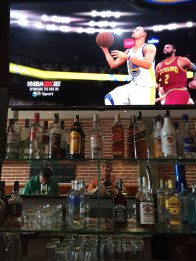
IMG_3897Found a sports bar across Da Nang that carries the Warriors/Thunder Western Championship Games.  The owner opens at 8:00am just as the game is starting, have to wait for the staff to show up for food however.  They wander in around half-time but cook a great imitation American breakfast. Also best bac xiu (iced Vietnamese coffee wth milk over ice) in town.  Universal 2 Cafe & Sports Pub, 230 Bach Dang.  Write it down if you’re coming out this way.
 

Beautiful Night in Da Nang

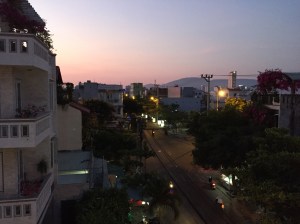
It’s one of those nights in Da Nang IMG_0015when the city seems to be bursting with more life than any city has the right to. Thousands of people, including my family, were down at the beach to see the full moon.  Today was a Buddhist holiday, it’s a Friday night in May, the weather is perfect, let the good times roll.
I would like to be able to report that I spent the day toiling on the book, but that, my friends, is not the case.  I did some writing, some intriguing research and a follow-up interview.  Didn’t exactly bust my hump, but made some headway.  I’m just gonna chalk it up to one of those days where your expectations far exceed your output.

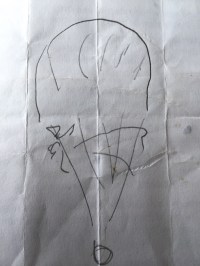
One of my uncles in Quang Ngai drew me a picture of the insignia on the beret worn by his long-dead brother. IMG_0004Said there was a tiger leaping across the parachute, that the beret was sometimes red, sometimes green.  I spent a fair amount of time time today in pursuit of his brother’s unit as it has a specific bearing on the storyline.
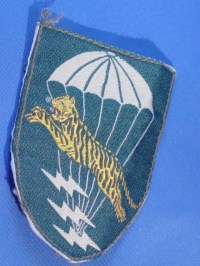
His brother was clearly a member of an elite Airborne Battalion.  I know he was stationed near Chu Lai in 1968, the rest is going to be an interesting puzzle to solve.  Here is the drawing I was given in Quang Ngai and here is one of the badges that comes close:

IMG_0003

One of the fascinating challenges about doing research on specific South Vietnamese soldiers is that it was apparently commonplace at the end of the war in 1975 to burn any evidence of any connection with the Republic of South Vietnam.  I have interviewed a number of people who have said, “oh, he burned all of that”, or “his mother burned all of the pictures and papers”.  Must have been a lot of little bonfires in those days.  I have yet to see a photo of a relative in uniform, including photos of myself.  Only one photo of me exists that the family kept after 1975: my high school senior yearbook picture.  I must admit that I didn’t look terribly intimidating in my rental tux.