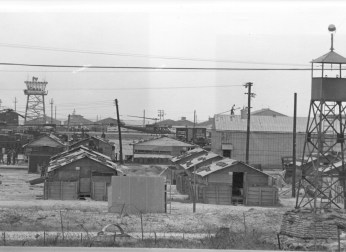
Bao, Da Nang, Vietnam 1971
Letter from Lena (excerpt): Bao told me once that his mother had actually, he thought, died of a broken heart, though it was the fever that finally took her. When Bao’s father had wooed his mother in Bang Sai, a village north of Bangkok, Thailand, married her and promised her that they would always live in her native Thailand, he had lied. He had lied and she knew he had lied, but wanted to believe so badly that she kept his house in a squalid village full of dirt poor ARVN families outside the American base at Chu Lai willing, begging the war to end. After the fighting she, Binh, and baby Bao could finally cross back into Thailand, the land of her people.
But in desperate times Fate is a taker rather than a giver. It was not Hom’s destiny to see her country or her family again, but rather to die slowly in a puddle of sweat on a bamboo mat as her crazy fever-driven visions wrestled her finally from this life. Bao was at her side continuously during her ordeal, wiping with a cool wet cloth her sweat drenched face, trying desperately to pry open her hands that had curled into claws as he burned incense, not to please the spirits but to mask the stench of impending death. When Hom’s struggle ended, as the spirits took her at last, as she breathed her last ragged breath, Bao dug a shallow grave for her beside the wreck of a hovel that they had called home since before his birth. He dug his mother’s grave with one half of a broken plate he had found next to her bed. No one from the village helped Bao, a half-breed, as he dug. He was burying a foreign mother in soil far from home, not her soil or the soil of her ancestors.
(excerpt): How Bao found me I do not know. How he was welcome on the base a mystery. That was his secret. Bao never shared that secret, but told me many other stories that will be with me always.
Bao was a fine conversationalist. Talking with him was a welcome break from exchanges with fellow soldiers that started with cars, ranged as far as what was waiting for them at home, a girlfriend perhaps, and eventually got back around to cars. Bao’s English was good and got better each time we talked. His memory and capacity for language was uncanny. We spent hours talking about what the world was like inside and outside of Vietnam. To Bao, there were only those two possibilities, his war-torn country and everywhere else. To him the distinction between the United States, Europe, Australia, even Africa did not exist. They were simply places that carried on nicely outside the known horror of Vietnamese killing other Vietnamese.
Bao didn’t care that the Americans were in Vietnam. There had always been outsiders telling his people what to do: Chinese, French, Japanese, Viet Minh, Americans, someday, Bao was convinced, the Communists from Hanoi. His indifference irritated me. As we sat in the shade one day dripping sweat and swatting bugs I asked him if the people of his country really believed in democracy. Brushing back his forelock slowly in an extreme gesture of patience one might reserve for the terminally stupid, he said, “We don’t know what democracy is. We just want peace.”
 letterfromlena